
Bridging the gap between print and digital
For a long time, print and digital have lived in separate worlds. Direct mail builds trust and delivers reliable responses. Digital brings data, interaction and real-time feedback. The opportunity lies in combining those strengths, and augmented reality provides a practical way to do that.
By layering digital content over physical print, AR transforms a static mail piece into something interactive, measurable and genuinely engaging. It keeps the impact of print while adding the measurability of digital.
Why direct mail still works
In a world of endless scrolling, notifications and algorithm changes, direct mail still cuts through. Traditional response rates typically sit within the 2–5% range, with interactive or enhanced formats shown to outperform static mail.
That’s partly because print occupies physical space. It’s visible in the home and it doesn’t disappear with a swipe. It’s also perceived differently. Many consumers see direct mail as more personal than online interactions – particularly when it’s tailored to their interests and needs.
That’s why, despite the growth of digital channels, direct mail continues to play a valuable role in the marketing mix.
What happens when you add AR to print?
AR doesn’t replace what makes print effective. It builds on it.

Increased engagement
Research from Mindshare shows that AR experiences can be up to 200% more engaging than non-AR equivalents. In print specifically, AR-enabled campaigns have been shown to significantly increase dwell time – in some case studies by up to 80–90% (PIWorld).
In simple terms, the longer someone spends engaging, the more likely your message is to stick.

Stronger recall
AR doesn’t just hold attention, it strengthens memory.
Mindshare reports that AR is three times more memorable than traditional non-AR media. Interactive print ads featuring AR have demonstrated up to 70% higher brand recall compared to static print (AdWeek).
Stronger recall is directly linked to improved response and purchase consideration.

Greater purchase confidence
AR also helps customers make decisions.
Research from NielsenIQ and Snap found that 56% of shoppers feel more confident about product quality when using AR, and 61% prefer to shop with retailers that offer AR experiences. The ability to explore a product in 3D, see it in context or interact with additional content reduces uncertainty.
That matters in sectors where trust and reassurance drive conversion.

Commercial impact
AR engagement has increased by nearly 20% since 2020, with conversion rates up to 90% higher for consumers who actively engage with AR compared to those who don’t (Retail Customer Experience).
In addition, 48% of shoppers are already using or are willing to use AR to assess products and services (Nielsen). Behaviour has shifted. Audiences are increasingly comfortable interacting with brands through immersive formats.
Put simply, engaged audiences are more likely to respond.
Why AR works particularly well in door drop campaigns
Door drops are designed to interrupt routine and spark curiosity – to make someone pause on their way back from the kitchen. AR builds on that.
Recent research from AR Insider shows that while native AR apps still account for the largest share of usage, a meaningful proportion of consumers are already accessing experiences via mobile web, activated with nothing more than a link or QR code. Many have been engaging with immersive content for several years, suggesting these mobile experiences are no longer niche or novel, but familiar and intuitive when delivered friction-free.
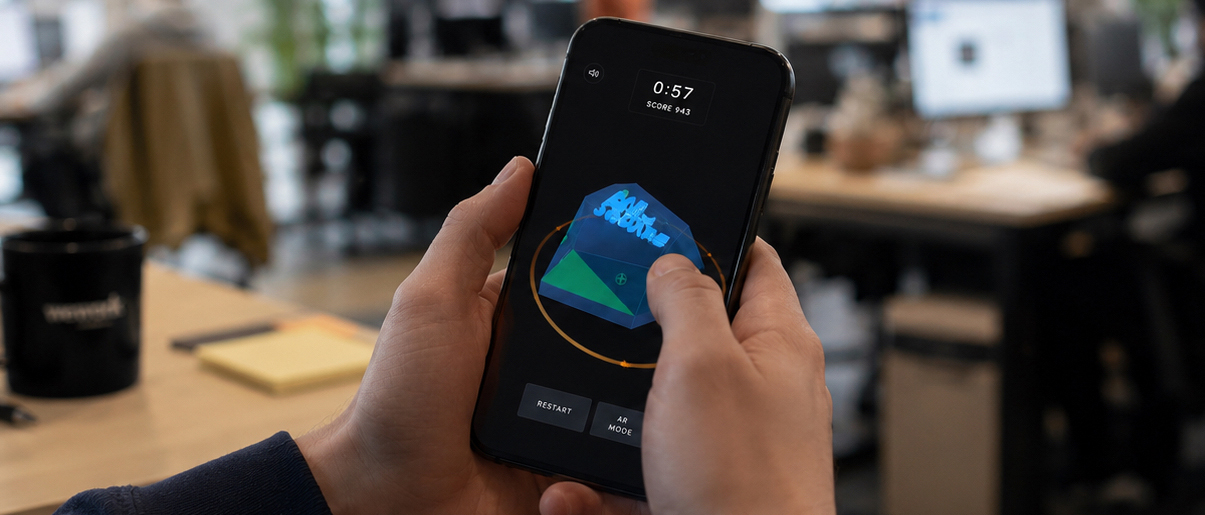
With QR codes now second nature and smartphone scanning behaviour normalised, launching a WebAR experience directly from a mailer is straightforward. There’s no app download required, users simply scan and engage in-browser. This creates a seamless bridge between the physical and digital journey:
Direct mail lands in the home
The recipient scans a QR code
A branded AR experience launches in-browser
The user interacts, explores or plays
A clear call to action drives purchase, booking or further content
Instead of ending at awareness, the direct mail becomes the start of a measurable interaction.
From print to performance: The measurement advantage
For marketers, ROI is key. Campaigns are increasingly judged not just on their creativity, but on measurable performance.
Unlike traditional static print, AR enables brands to measure engagement, including scan rate, dwell time (time spent engaging with the experience), click-through behaviour and conversion actions.
This data enables smarter follow-up activity, from retargeting to timed reminders. It allows print to play a role in a broader omnichannel strategy, rather than sitting in isolation.
At a time when print production costs are rising, proving performance matters more than ever.
Practical applications of AR in print
AR can support a wide range of campaign objectives. Most campaigns start with a QR code that launches a WebAR experience, paired with a clear call to action such as book, buy, claim or register. The journey should be short and intuitive. The mailer is the prompt, not the whole experience. AR can then be used to layer further information on top, for instance:
Product visualisations or 3D demos
Interactive explainer content
Personalised video messages
Gamified experiences or prize draws
Vouchers or incentivised offers
AR works best when it supports the campaign objective rather than trying to do too much. The focus should be on clarity and action. The approach can vary significantly depending on sector and objective.
A retail brand targeting younger audiences might use a playful AR game triggered from a door drop – encouraging users to collect items, unlock rewards or share results socially. The mailer becomes a gateway to interaction rather than just an offer, increasing dwell time and extending reach beyond the original recipient.
A healthcare or service-led brand might use AR to deliver education in a more human, accessible way than static print allows. For example, a veterinary practice could bring a friendly character or virtual vet to life, explaining the importance of regular check-ups, vaccinations or preventative care. This allows more information to be delivered than a door drop alone, while maintaining warmth and approachability. A clear call to action can then guide pet owners towards booking an appointment or learning more.
In sectors where reassurance drives conversion – such as property, home improvement or automotive – AR can allow users to visualise products in context, explore features in 3D or compare options interactively. This added confidence can shorten decision cycles and increase response rates.
In summary
Direct mail already performs. The opportunity is to make it work smarter.
Augmented reality in direct mail campaigns increases attention, strengthens recall and turns a static mail piece into a measurable performance channel. It connects physical reach with trackable digital insight.
For brands looking to bridge physical and digital journeys without losing the impact of print, AR isn’t a gimmick. It’s a practical way to improve response, and a timely opportunity to engage audiences in more interactive, measurable ways.
Frequently Asked Questions
Do AR direct mail campaigns require an app?
No. Most campaigns use WebAR which launches directly in the mobile browser after scanning a QR code. WebAR negates the need to download an app, which reduces friction and increases the likelihood of engagement. The experience looks like a webpage, but features interactive AR content overlaid onto the real world.
How do you measure AR engagement from a mailer?
AR adds a digital layer to print, which means engagement can be tracked in the same way as other digital experiences. When someone scans a QR code and launches a WebAR experience, interactions can be captured through integrated analytics. This allows you to measure metrics such as QR scan rate, dwell time, click-through behaviour and conversion actions. This data provides insight into how users interact with experiences, helping to refine the journey and inform future strategy.
Is augmented reality in direct mail expensive?
Costs vary depending on the complexity of the AR experience. AR projects can be designed and scaled to suit different budgets and objectives, making them accessible across a range of campaign sizes.
Curious what this looks like in practice? Explore our AR case studies to discover how interactive experiences drive engagement and measurable results, or get in touch to discuss how AR could enhance your next print campaign.