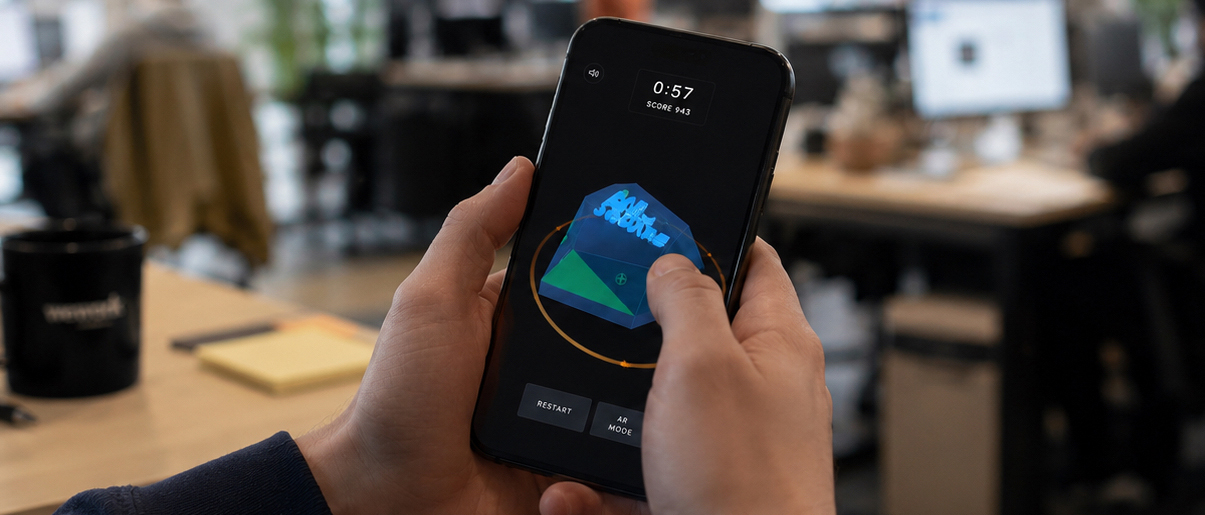
Want to play for yourself? Just head on over to game.farfromsquare.io and see where you end up in the rankings, then head back here to read the article!
What’s ‘Proof of concept’ about a simple browser game?
As you may already know, we’re a studio which focuses mainly on immersive tech. That means AR, VR, smart glasses, interactive screens and projections, and anything which is adjacent to those tech areas.
One thing you tend to find when looking at WebAR experiences in general is that they’re very focused on the ‘AR’ part rather than muti-modal. This isn’t surprising as building a WebAR experience is a significant undertaking and the licenses for tracking solutions such as Zappar and 8th Wall have been pretty costly until recently. (I say ‘until recently’ because 8th Wall recently open-sourced much of their technology and made it available to use free of charge.) This means that the barrier to entry for WebAR suddenly dropped significantly. It also means we can start to experiment a lot more, and build hybrid experiences – ones which work both as normal Web3D, but also with an AR component, and that is a big part of what the PoC part of this project was about.
This game will play just as well on a desktop browser as it does in AR mode on a mobile browser, and it means we get to test which interaction mechanics work well across both pointer and touch based browsers, and which work well across both normal Web3D and AR experiences (which are more different than you might expect). We’re not forcing the player down any particular route and we’re trying to give largely the same experience to everyone.
So what did we learn along the way?
We did quite a bit of cold testing of the game to get a feel for how well people were getting to grips with it, and how they were using it.
We purposefully didn’t give any guidance at all on how people should play the game, what they should play it on, etc, we just let the testers decide for themselves. Overall the feedback on the game itself was the usual bell-curve of some saying it was too easy, some too hard, some saying it was super simple, some saying it was too complicated, etc.
No one told us they couldn’t complete the game or had given up, which itself told us it was probably in the sweet spot - just difficult enough to keep people trying, but not so difficult players were quitting out of distraction. Some gentle tuning here and there had it dialed in to a place where we were very happy with it.
In terms of how people chose to play the game, that was largely down to how they received it. We sent emails and WhatsApp messages to most of the testers with the test link. Some opened on desktop, some on mobile. What we found was that everyone played it there and then and if they played it on desktop they didn’t then think to play it on mobile, and vice versa. When we asked how the players felt the experience compared across the two formats we often got the response was that they hadn’t realised it could be played across both mobile and desktop because it felt native on the device they were playing it on.
Also of interest was how many players found their way to the AR mode unprompted. Which, as it turned out, was quite a few, with many giving feedback that it was ‘quite cool’ and having fun placing the game puck around their house. A win then for AR! Two learnings here then – users will often try AR if they have the option available to them, and open source 8th Wall works well across different platforms and is a solid free of charge option for WebAR.
From a technical standpoint, native audio support still seems like a weak spot for games and experiences built on the web. In game engines like Unity and Unreal this stuff is nailed down as you’d expect, but on the web (HTML5 audio) the experience is still super inconsistent, with volume levels not easy to manage, playback inconsistent or laggy and generally weird behaviour. We also found that adding audio seemed to add a significant amount of processing overhead to the game which was unexpected, especially as the audio clips were all very short and heavily compressed down to tiny file sizes. This reminds us that as impressive as web-browsers have become at these sorts of 3D experiences recently, there are still some things where a dedicated game-engine/app still has the edge (for now). Next time out we’ll take a look at Howler.js and see if we can get some better results, but for this one we didn’t want to add the additional dependency once we got everything running.
In conclusion
It’s definitely possible to build quite complex interactions in Web3D and have those translate cleanly to WebAR whilst feeling natural and satisfying in both settings. And with 8th Wall’s now free AR engine available to everyone, it’s now much more cost effective to build WebAR experiences which work well across a whole range of devices.
Want to play for yourself? Just head on over to game.farfromsquare.io and see where you end up in the rankings!